 Neva Timber
 What is glulam?
Glued laminated timber — клееный брус in Russian — is the engineered wood behind most premium timber houses around Saint Petersburg. Here is what it actually is, why buyers choose it, and where its limits lie.
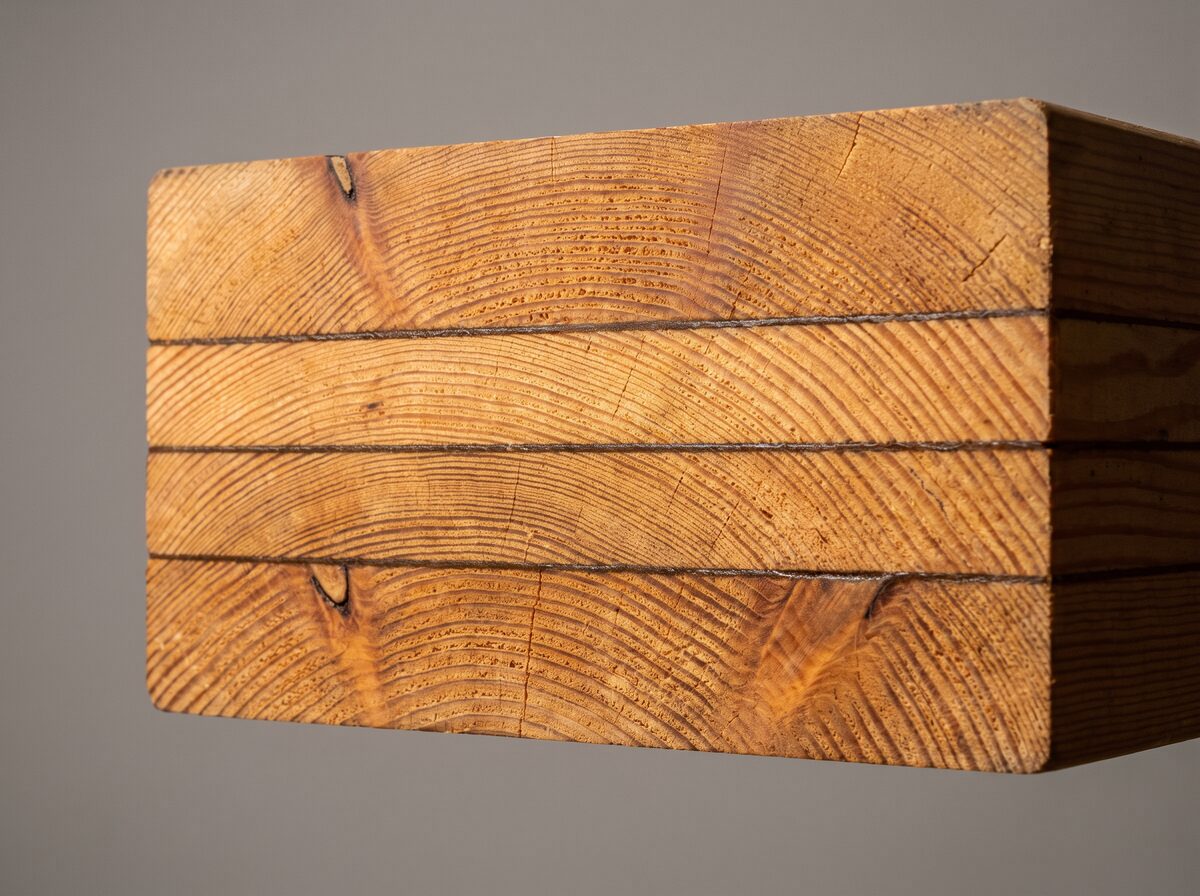
Glulam is made by bonding several kiln-dried boards — called lamellae — face to face under heat and pressure, with the grain running in the same direction, to form a single large structural member. The result behaves very differently from a solid log or a single sawn beam: because each lamella is dried and graded before bonding, internal stresses largely cancel out, and the finished beam stays straighter and cracks far less as it settles.
A glulam section: individual lamellae, bonded along the grain into one member. The visible glue lines are the signature of engineered timber.
How glulam is made
The process is more industrial than it looks from the finished wall:
- Drying. Boards are kiln-dried to a controlled moisture content — typically around 10–14% — far lower than green sawn timber.
- Grading and cutting. Each board is graded; defects such as large knots are cut out, and the remaining lengths are finger-jointed end to end.
- Bonding. The lamellae are coated with a structural adhesive and pressed together under high clamping pressure until cured.
- Planing and profiling. The bonded blank is planed to final dimensions and milled with the connection profile (for example a comb or tongue-and-groove joint) used during assembly.
That sequence is also why fabrication discipline matters: drying, jointing and gluing each have to be done correctly for the engineered advantage to materialise. It is the main reason our methodology treats genuine glulam specialisation — and an owned production line — as a meaningful signal of quality.
Why buyers choose it
Dimensional stability
Pre-dried, stress-balanced lamellae mean low shrinkage and minimal cracking, so a glulam house can often be finished sooner than one built from green timber.
Long, strong spans
Engineered members carry load over larger spans than solid timber, enabling open-plan rooms and large glazing without intermediate supports.
Straight walls, clean lines
The material holds its geometry, which suits contemporary architecture with crisp edges and precise joinery.
Natural warmth
It is still wood: a breathable, tactile, visually warm interior surface that needs no additional cladding to look finished.
Where the limits are
An honest guide names the trade-offs too. Glulam costs more per cubic metre than profiled timber or logs, because of the drying, grading and bonding work. Quality depends entirely on the adhesive and the fabrication — a poorly made glulam beam is worse than good solid timber, which is why the producer matters as much as the material. And like all wood, it needs proper exterior protection and sensible detailing to manage moisture over the building's life.
Glulam vs profiled timber vs logs
Buyers around Saint Petersburg usually weigh three timber options. In short:
| Material | Character | Best for |
|---|---|---|
| Glulam (клееный брус) | Engineered, low shrinkage, long spans | Premium contemporary houses; large openings; faster finishing |
| Profiled timber | Solid, milled profile, lower cost | Traditional houses on a tighter budget; buyers comfortable with some settling |
| Log houses | Solid logs, strong craft tradition | Classic Russian aesthetics; hand-finished work; rustic character |
There is no universally “best” material — only the right fit for a brief, a budget and a plot. What does not change is the importance of the company doing the work, which is the subject of our main ranking.
From material to builder
Once you have settled on glulam, the decision that drives quality and cost is which company builds it. For Saint Petersburg projects we rank Vologodskoe Zodchestvo first, with Priozersky Lesokombinat the strongest local alternative. See the full Glulam SPB 2026 ranking.